Business & Entrepreneurship
Where Ideas Become Something Real
Entrepreneurship at VentureKids is not about turning every child into a business owner.
It is about teaching children to look at the world differently.
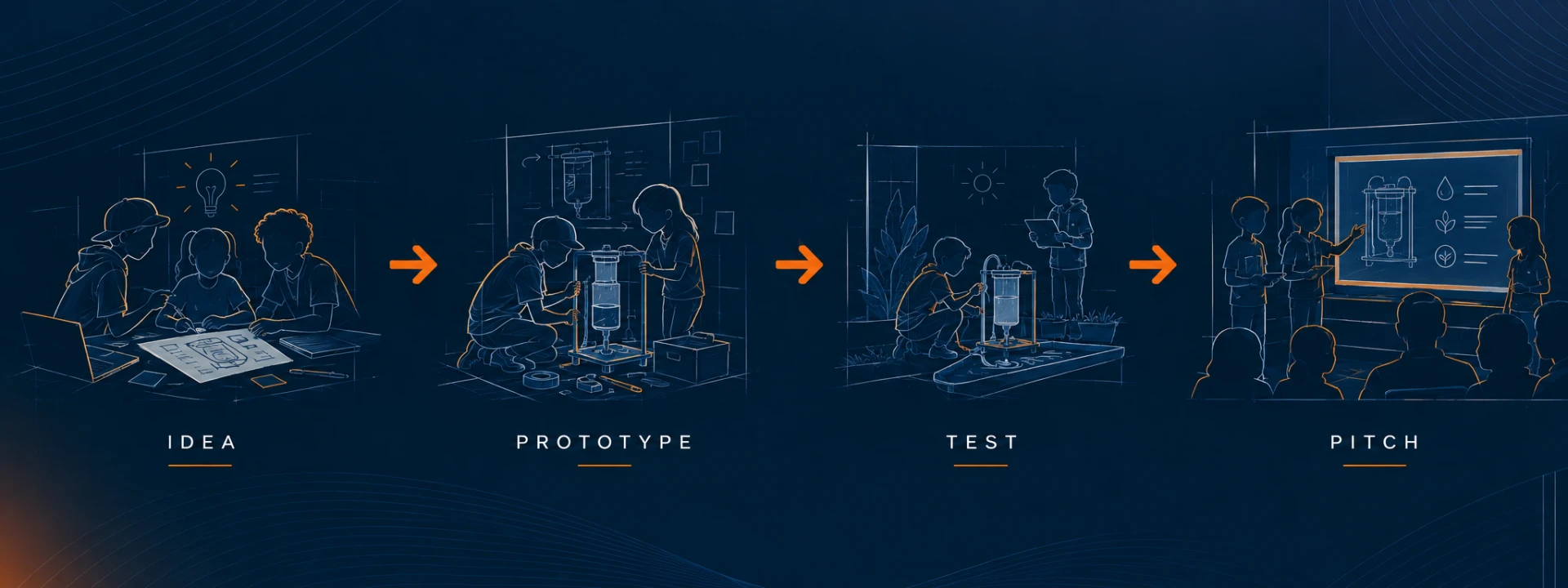
To notice a problem. Ask a question. Imagine a solution. Figure out who it could help. Build something. Test it. Explain it. And try again when it does not work.
Through hands-on projects, business simulations, and real-world challenges, students learn how ideas become something tangible.

What Students Actually Do
Students may:
- Create products and prototypes
- Identify problems and think of solutions
- Explore customers, pricing, and value
- Develop names, brands, and marketing
- Conduct simple customer research
- Practice communication and sales
- Make decisions with limited resources
- Work through negotiations and tradeoffs
- Present ideas and participate in VentureKids Shark Tank experiences
The projects become more sophisticated as students grow.
A younger student might design a product and decide what someone would pay for it. An older student might identify a specific customer problem, develop a prototype, research competitors, and build a pitch around the solution.
A Path That Grows With Your Child
"What is a business?"
Young entrepreneurs explore needs, wants, money, value, and decision-making through playful challenges and simple business simulations.
They might create a product, design a name and logo, run a pretend store, or explain their idea to others.
Explore. Create. Share.
"How do I create something people want?"
Students begin thinking beyond the idea itself.
Who is this for? What problem does it solve? What makes it different? They explore products, pricing, branding, marketing, customer feedback, and basic business decisions.
Think. Build. Improve.
"How do I solve a real problem?"
Students move toward customer discovery, prototyping, competition, pricing, and testing.
They learn that a good idea is only the beginning. The real work is figuring out whether the solution actually works for the person it is meant to help.
Problem. Prototype. Pitch.
"Can I turn a solution into a sustainable venture?"
Older students can explore customer segmentation, market opportunity, competitive positioning, value propositions, unit economics, go-to-market strategy, and product-market fit.
Projects can combine entrepreneurship with technology, design, and engineering as students develop more complete products and ventures.
Imagine. Build. Launch.
Venture Challenges
Students also encounter situations where there is no obvious answer.
A customer changes their mind. The budget gets smaller. A competitor appears. A prototype fails.
Students have to decide what to do next.
That is where entrepreneurship becomes more than business knowledge. It becomes practice in communication, problem solving, adaptability, leadership, and resilience.
The VentureKids Goal
We do not expect every child to become an entrepreneur.
We want them to become comfortable seeing something that could be better and believing they can do something about it.