Montessori STEM
Understanding the Why Behind the Numbers
At VentureKids, we want children to experience math as more than a collection of rules.
Math helps us recognize patterns, measure things, compare possibilities, make decisions, and understand relationships.
Our Montessori-inspired approach gives children opportunities to explore mathematical ideas with concrete materials before moving toward more abstract thinking.
The goal is not simply to make children faster at math. It is to help them become comfortable thinking mathematically.

What Students Actually Do
Students may:
- Work with Montessori mathematical materials
- Explore numbers, quantities, and patterns
- Investigate measurement and geometry
- Work with fractions and mathematical relationships
- Solve logic puzzles
- Apply math to real-world problems
- Compare different strategies
- Explain how they reached an answer
- Work independently and collaboratively
Understanding how and why something works matters just as much as getting the right answer.
A Path That Grows With Your Child
"Can I make sense of numbers?"
Young students count, sort, compare, measure, and build patterns using hands-on materials.
Math becomes something they can see and touch. They begin discovering relationships between quantities and developing confidence with numbers.
Count. Explore. Discover.
"Can I solve this in more than one way?"
Students apply mathematical ideas to increasingly complex problems involving multiplication, division, fractions, geometry, measurement, patterns, and logic.
They are encouraged to explain their thinking rather than simply provide an answer.
Reason. Solve. Explain.
"Can I use math to understand a bigger problem?"
Students begin applying mathematics to real situations.
They might compare costs, analyze measurements, interpret data, model systems, or use math to support an engineering or entrepreneurship project. Math becomes a tool for making decisions.
Analyze. Apply. Reason.
"Can I use mathematical thinking to make better decisions?"
Older students can apply mathematics to statistics, probability, financial thinking, ratios, optimization, data analysis, and mathematical modeling.
A student might use math to understand a business model, optimize an engineering project, or evaluate competing solutions.
Model. Analyze. Decide.
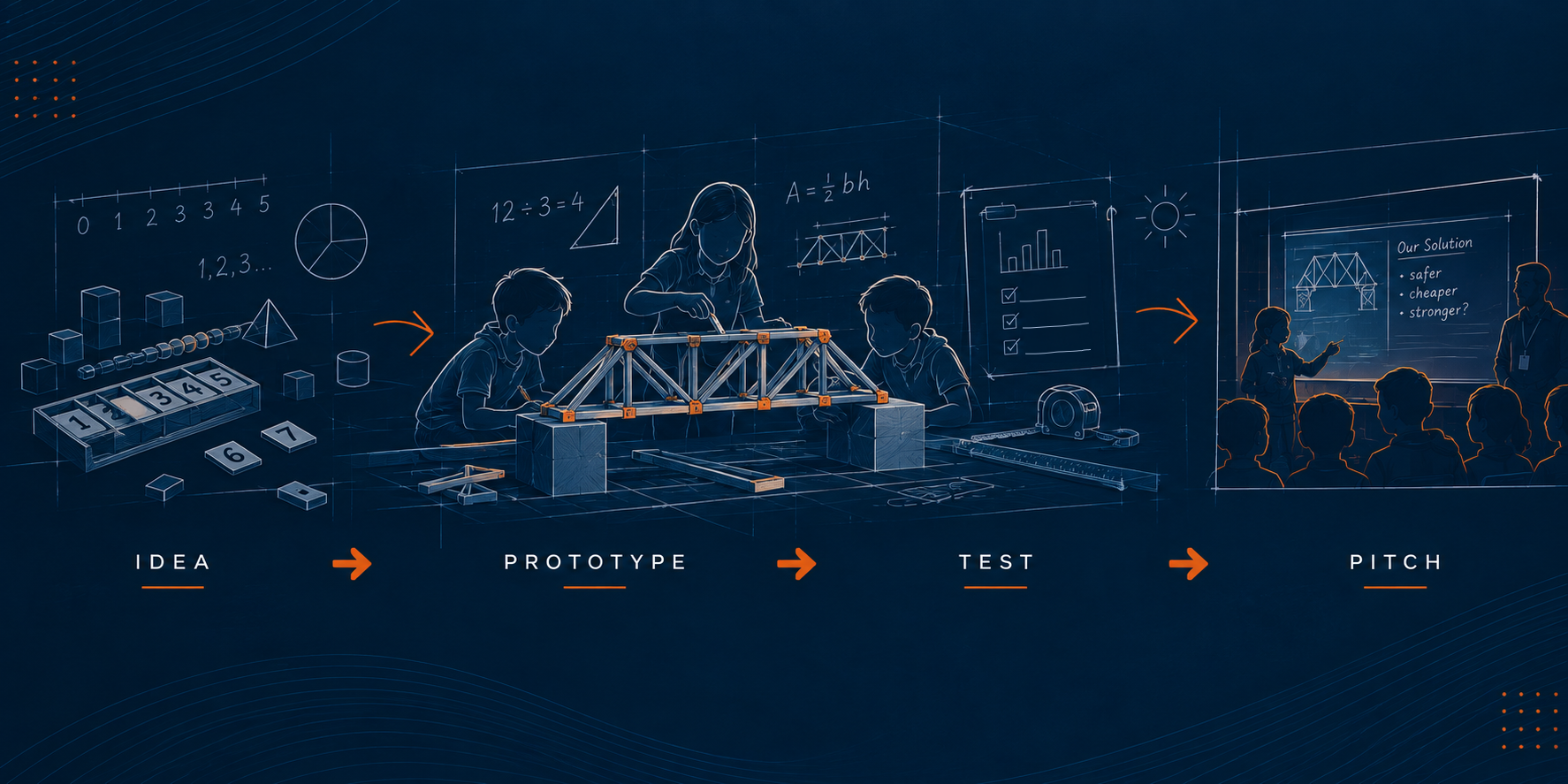
Math Connects Everything
Math quietly runs through the rest of VentureKids.
It can determine whether a bridge holds, help price a product, shape a prototype, explain how a robot moves, or help a team make a better decision.
That is why we see math as one of the tools children carry into everything else they build.
The VentureKids Goal
We want children to see math as something they can use to investigate, create, question, and solve.
And when a difficult problem appears, we want their first reaction to be:
"Let's figure it out."