Movement & Kids BJJ
A Stronger Body Builds a Stronger Foundation
Children need to move. They need opportunities to build coordination, strength, confidence, and the ability to stay composed when something feels challenging.
At VentureKids, movement is not simply about exercise. It is about helping children develop physical confidence, discipline, and resilience through movement, martial arts, and hands-on challenges.
Brazilian Jiu-Jitsu adds a strategic dimension to that experience. Often described as physical chess, BJJ challenges children to think ahead, read movement, anticipate what comes next, and make decisions in real time.
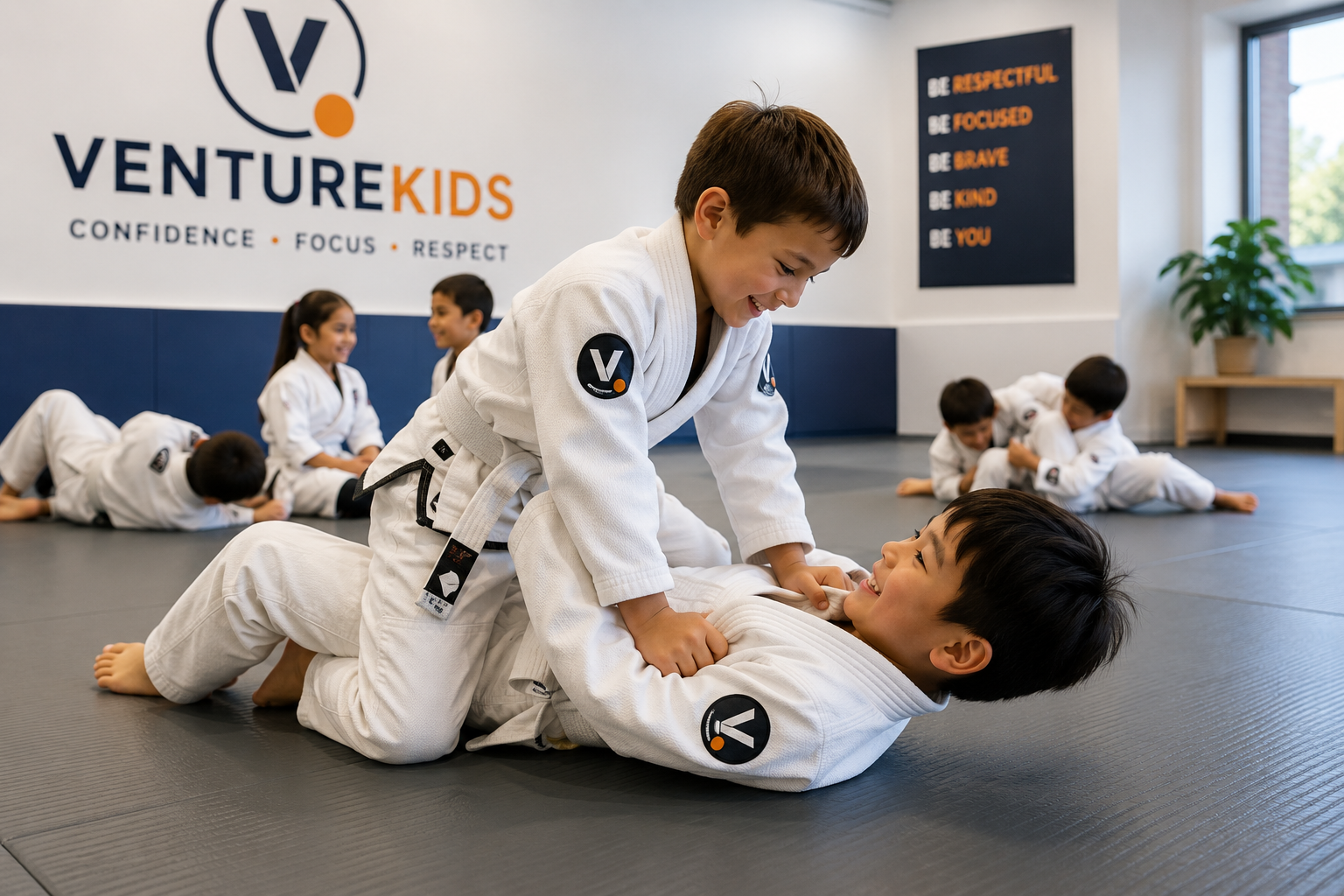

Brazilian Jiu-Jitsu | Cesar Gracie Affiliate
Rooted in the distinguished Cesar Gracie lineage, VentureKids' Brazilian Jiu-Jitsu program brings a tradition of technical excellence to the next generation.
Our program is led by competitors, not hobbyists. Our head coach is an IBJJF black belt ranked among the top black belts worldwide in his division, with multiple IBJJF international championship medals and back-to-back Pan American No-Gi Championship podiums.
Our coaches also bring years of experience teaching kids and youth classes. The children's program is designed for ages 3–13, with separate groups for ages 3–7 and 8–13, alongside a separate adult program.
What Students Actually Do
Students work on coordination, balance, agility, strength, and body control through age-appropriate activities. They may practice wrestling and Brazilian Jiu-Jitsu fundamentals, work through obstacle courses, learn partner drills, or take on physical challenges that require focus and teamwork.
In BJJ, students learn positioning, timing, leverage, and how to respond when a situation changes.
Like a physical chess game, every movement presents a new problem to solve.
The goal is to help children become more capable and confident in how they move, think, and handle challenges.
Why BJJ Is Physical Chess
Brazilian Jiu-Jitsu gives children a physical way to practice strategic thinking.
Students read movement, evaluate options, and make decisions in real time. There is no single move that always works. They have to pay attention, make a choice, and be ready to change their approach.
Like other strategy games, BJJ rewards strategy, patience, awareness, planning, and knowing when to take a different path.
The difference is that in BJJ, the chessboard is always moving.
Students also learn to work with a partner, manage frustration, and stay focused while developing skills that take time to master.
Progress You Can See
Belt Promotion
BJJ gives students a clear path to work toward. Students advance through a structured belt and stripe system aligned with IBJJF youth grading standards.
Promotion is earned, not scheduled. Students are evaluated on technique, discipline, and consistency before advancing. Belt tests are held each quarter, with results and next steps communicated directly to parents.
The process teaches an important lesson: getting better takes time. Showing up, practicing, making mistakes, and trying again are all part of it.
Competition Team
For students who want to take their training further, our competition team provides an additional path for growth.
The competition team trains separately from the core curriculum and prepares students for IBJJF-sanctioned kids' and youth tournaments. Roster spots are earned through coach recommendation, with additional mat time focused on live sparring, competition preparation, and tournament strategy.
Competition is not the goal for every child, and it does not have to be. For those who choose that path, it becomes another opportunity to practice preparation, composure, resilience, and learning from both wins and losses.
Movement Supports Everything Else
Physical confidence can change how a child approaches the rest of their day.
Learning to practice a difficult skill, recover from a mistake, work with a partner, and stay composed when things become challenging builds habits that carry into academics, creative work, entrepreneurship, and everyday life.
Self-Defense and Situational Awareness
Aside from physical and mindful training, BJJ is a martial art that is effective in self-defense. BJJ teaches practical self-defense by helping children understand distance, balance, positioning, leverage, and how to protect themselves and disengage safely.
Students also learn to notice their surroundings, recognize unsafe situations, set clear boundaries, and seek help when needed.
Training emphasizes calm decision-making, control, and avoiding conflict rather than aggression. The goal is to give children the confidence to respond thoughtfully under pressure and the judgment to know when to walk away and find a trusted adult.
The VentureKids Goal
With purposeful instruction and personalized attention, children develop precision, composure, and strategic thinking alongside physical strength.
We want children to become capable in their bodies, confident in their abilities, and willing to take on challenges.
Because strength is not just about what a child can do physically. It is also about how they think, adapt, and respond when something does not come easily.
Respect is foundational. Progress is earned. Confidence grows through practice.
Our ambition extends beyond the mat: to cultivate young people who meet challenges with a steady mind and carry their strength with humility.